Building Stronger Research
Through Patient Partnerships
Webinar summary | 20 January
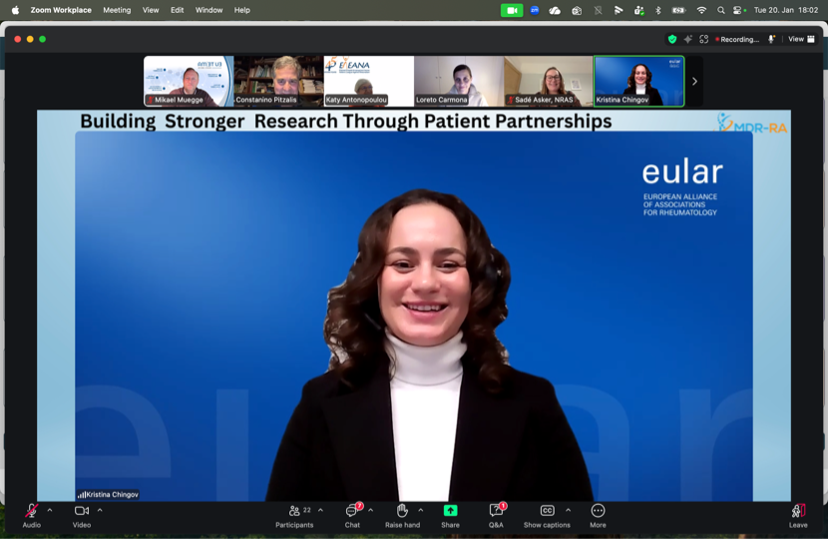
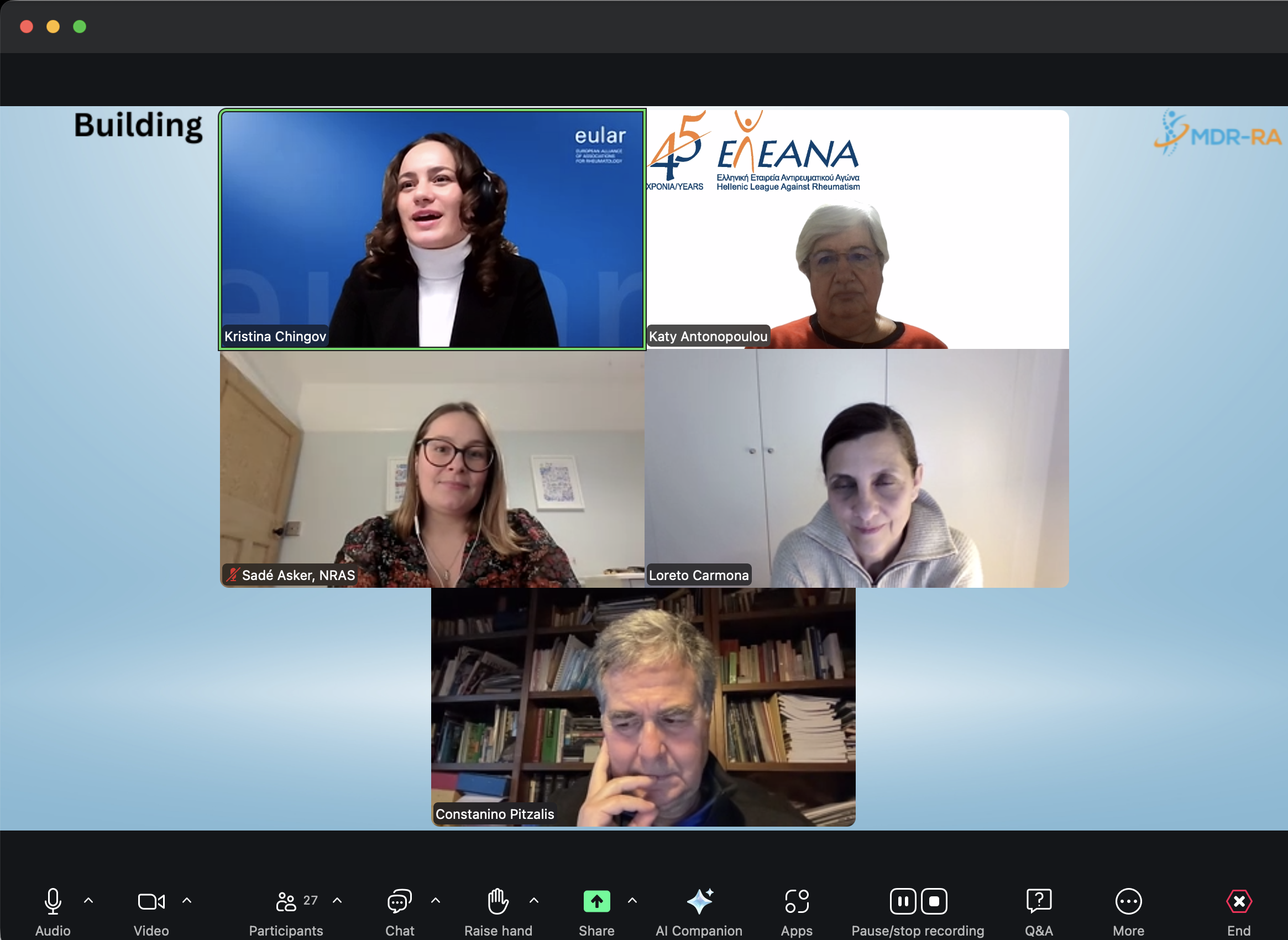
On 20 January, the MDR-RA consortium hosted its first live public webinar, “MDR-RA Insights: Building Stronger Research Through Patient Partnerships”. The event chaired by Kristina Chingov (EULAR) brought together patients, patient research partners (PRPs), patient organisations, clinicians, and researchers to explore how meaningful patient involvement is shaping the MDR-RA project from design to implementation.
Placing patient perspectives at the centre of complex biomedical research is a core principle of MDR-RA. This webinar marked an important milestone by opening this collaborative approach to a wider audience and demonstrating how patient partnerships strengthen both the scientific quality and real-world relevance of the project.
Introducing MDR-RA: addressing a major unmet need
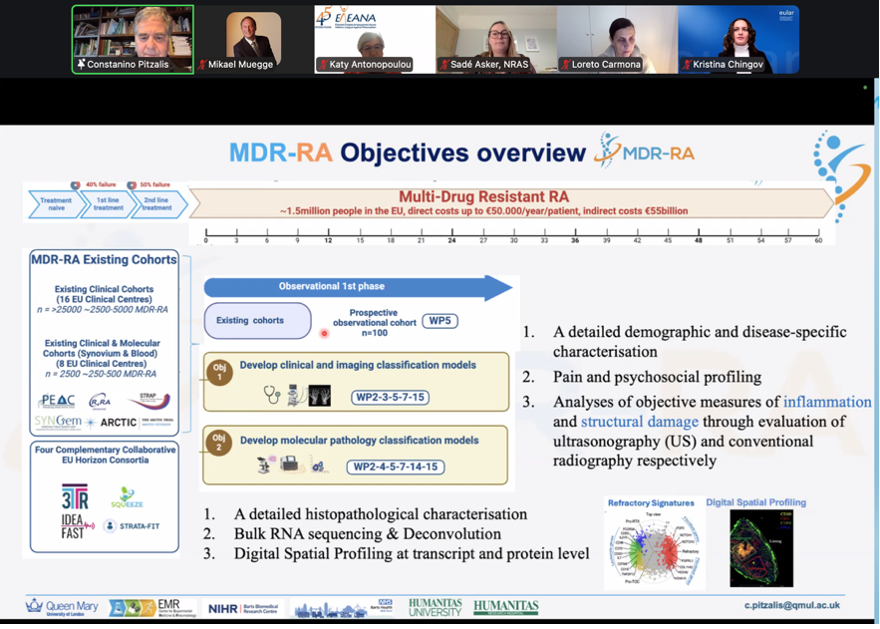
The webinar opened with an overview of the MDR-RA project by Professor Costantino Pitzalis (Humanitas University, Milan & Queen Mary University of London), the project’s Principal Investigator. He outlined the urgent challenge MDR-RA seeks to address: multidrug-resistant or difficult-to-treat rheumatoid arthritis (RA), a condition affecting a substantial proportion of people living with RA and associated with high disease burden, reduced quality of life, and significant societal and healthcare costs.
MDR-RA brings together 23 partners across 12 European countries to define the clinical and molecular mechanisms underlying treatment resistance in RA. By combining deep clinical, imaging, and molecular phenotyping with advanced data analytics, the project aims to move beyond “trial-and-error” treatment approaches towards more precise, personalised care strategies.
Crucially, Professor Pitzalis emphasised that patients have been involved in MDR-RA from the very beginning — including during proposal development — and continue to contribute across all work packages, from governance and ethics to trial design and evaluation.
Patient involvement as a structured, integral process
Katy Antonopoulou, Patient Research Partner and webinar host, provided a clear overview of how patient involvement is embedded within MDR-RA through a dedicated Patient Engagement Plan. Rather than being treated as an add-on, patient involvement is designed as a continuous, structured process throughout the project lifecycle.
The engagement model rests on two complementary pillars:
- Patient Research Partners (PRPs), who actively contribute to scientific discussions, ethics, management, communication activities, and the co-creation of tools such as the iCare-RA model.
- National patient organisations, which act as trusted bridges between the project and wider patient communities, supporting dissemination, outreach, and two-way communication at national level.
PRPs work collectively as a Patient Advisory Panel, bringing diverse perspectives shaped by different healthcare systems, cultures, and lived experiences. Their role is not only to share personal stories, but to help translate scientific complexity into outcomes that are meaningful for people living with difficult-to-treat RA.
The role of patient organisations: the NRAS perspective
Sadé Asker, Patient Research Partner and Senior Policy Officer at the National Rheumatoid Arthritis Society (NRAS, UK), highlighted the vital role of patient organisations in supporting MDR-RA. She described how NRAS will disseminate project updates and results through its extensive UK networks, including its online community of nearly 40,000 members.
Drawing on real-world experience, Sadé illustrated the unmet needs faced by people living with refractory RA and explained how organisations like NRAS provide peer support, helplines, research recruitment, and patient and public involvement services. These activities not only amplify the reach of MDR-RA but ensure that research remains closely aligned with patient priorities and realities.
How patients shape the iCare-RA model in practice
Professor Loreto Carmona (Institute for Musculoskeletal Health, INMUSC, Madrid), leader of Work Package 6, presented how patient input directly informs the development of the iCare-RA model — a central output of MDR-RA.
The iCare-RA approach combines:
- a Clinical Decision Support System (CDSS), integrating clinical, imaging, and molecular data to support treatment decisions; and
- a broader CARE model, which defines care pathways, roles, resources, and shared decision-making processes.
Patient Research Partners have played a key role in defining what this model should deliver: holistic, patient-centred care; reduced uncertainty; shared decision-making; consideration of comorbidities and quality of life; and feasibility within real-world clinical constraints. Discussions also addressed challenges such as varying standards of care across countries, limited consultation time, and managing expectations while remaining pragmatic.
Open discussion and shared learning
The webinar concluded with a lively discussion, addressing questions on clinical implementation, health system readiness, and lessons for other research projects seeking to build strong patient partnerships. Speakers highlighted that while full implementation will come later, MDR-RA is already laying the foundations by testing the iCare-RA model and evaluating its clinical and health-economic value.
A recurring message throughout the discussion was clear: involving patients early, consistently, and meaningfully is not only ethically important, but scientifically essential - particularly in complex, high-burden conditions such as multidrug-resistant RA.
Looking ahead
This first MDR-RA webinar demonstrated the consortium’s commitment to transparency, collaboration, and patient-centred innovation. By bringing together patients, clinicians, researchers, and organisations in an open dialogue, MDR-RA continues to build a shared vision for improving care and outcomes for people living with difficult-to-treat rheumatoid arthritis.
Further webinars and engagement activities are planned as the project progresses, continuing to place patient voices at the heart of MDR-RA.
View the full webinar here:
https://youtu.be/vPLmWvO4Kbk