Patient hub
When Rheumatoid Arthritis Is Harder to Treat, You’re Not Alone
This space has been created for people living with difficult-to-treat rheumatoid arthritis, Patient Research Partners, patient organisations, and anyone who would like to understand how patients are actively shaping this research. MDR-RA is committed to ensuring that research is not only done for patients but truly co-created with patients. In this hub, you will find information about the project in understandable language, updates on our progress, and insights into how patient perspectives are integrated throughout the research process.
Here, we aim to:
• Explain what the MDR-RA project is about and why it matters for people living with difficult-to-treat rheumatoid arthritis
• Share how patients have been involved from the very beginning - including during the research project proposal phase
• Highlight the role of ourPatient Research Partners and collaborating patient organisations
• Provide resources, materials, and opportunities to stay informed or get involved
This hub is a living space. As the project evolves, this section will be updated regularly - reflecting our shared commitment to partnership, transparency, and meaningful patient engagement.
MDR-RA Insights Webinar : Building Stronger Research Through Patient Partnerships
On 20 January, the MDR-RA consortium hosted its first public webinar, bringing together patients, clinicians, researchers, and patient organisations to explore one key question: how can patient partnerships truly strengthen research? View the full webinar here:
https://youtu.be/vPLmWvO4Kbk
Rheumatoid arthritis (RA) can be painful, exhausting, and life changing. When several medicines stop working or never work well, this is called multi-drug-resistant RA. MDR-RA is an European research project that aims to improve treatment options and reduce the prolonged search for the right treatment for people in this situation.
Understanding rheumatoid arthritis
Rheumatoid arthritis (RA) is a chronic inflammatory condition that affects the joints, causing pain, stiffness, swelling and fatigue. While many with RA achieve good disease control with available treatments, this is not the case for everyone.
What does ‘multi-drug-resistant’ mean?
Multi-drug-resistant RA refers to a situation where a person has tried several treatments commonly used to treat RA - including biologic or targeted therapies - but the disease remains active. Despite these efforts, symptoms such as pain, fatigue, and reduced physical function can persist, significantly affecting daily life.
How many people are affected?
RA affects millions of people worldwide, including around 7 million in Europe. A meaningful proportion of patients experience inadequate response to multiple treatments, placing a considerable burden on their quality of life, mental health and increasing healthcare needs.
Why research is needed
For people living with multi-drug-resistant RA, treatment often involves a prolonged process of trial and adjustment. This can be physically and emotionally challenging. Research in this area aims to better understand why some treatments are not effective for certain individuals, identify early indicators of treatment response, and support more personalised approaches to care - helping patients access the most suitable treatment sooner.
Our goal: reducing treatment failure in rheumatoid arthritis
MDR-RA is a European research project funded by the EU. It brings together hospitals, universities, patient organisations, and data experts from across Europe. Together, they are working to improve how treatment decisions are made for people living with multi-drug-resistant rheumatoid arthritis.
A more supportive approach to treatment
For many people, finding the right treatment can take time. It often involves trying different medicines before one works well. This process can be frustrating and tiring, thereforeMDR-RA supports a more personalised approach to care.
How the project works
Phase 1 – Learning from real-life data
The project looks at information from everyday clinical care across Europe. This helps researchers understand how different people respond to treatments, and whether there are early signs that a medicine may or may not work.
Phase 2 – Testing a new decision tool
Based on these findings, MDR-RA is developing a tool (iCare-RA) to support and guide doctors in choosing treatments. The tool is tested in real clinical settings to see whether it helps improve care compared to usual practice.
What this could mean for patients
- Less time spent trying treatments that do not work
- A better chance of finding the right treatment sooner, leading to better outcomes
- Care that is more closely tailored to individual patients
- More efficient use of healthcare resources, helping support care for everyone
We are grateful to all patients and patient representatives who contribute their time, expertise, and lived experience to strengthen this research.
Who are Patient Research Partners?
Patient Research Partners (PRPs) are people living with rheumatic conditions, such as rheumatoid arthritis, who are actively involved in research projects from the onset as equal members of the team. The concept of PRPs was developed by European Alliance of Associations forRheumatology (EULAR) to ensure that research reflects the real needs and experiences of people living with these conditions. MDR-RA collaborates with a diverse group of nine PRPs from several European countries.
The Patient Advisory Panel
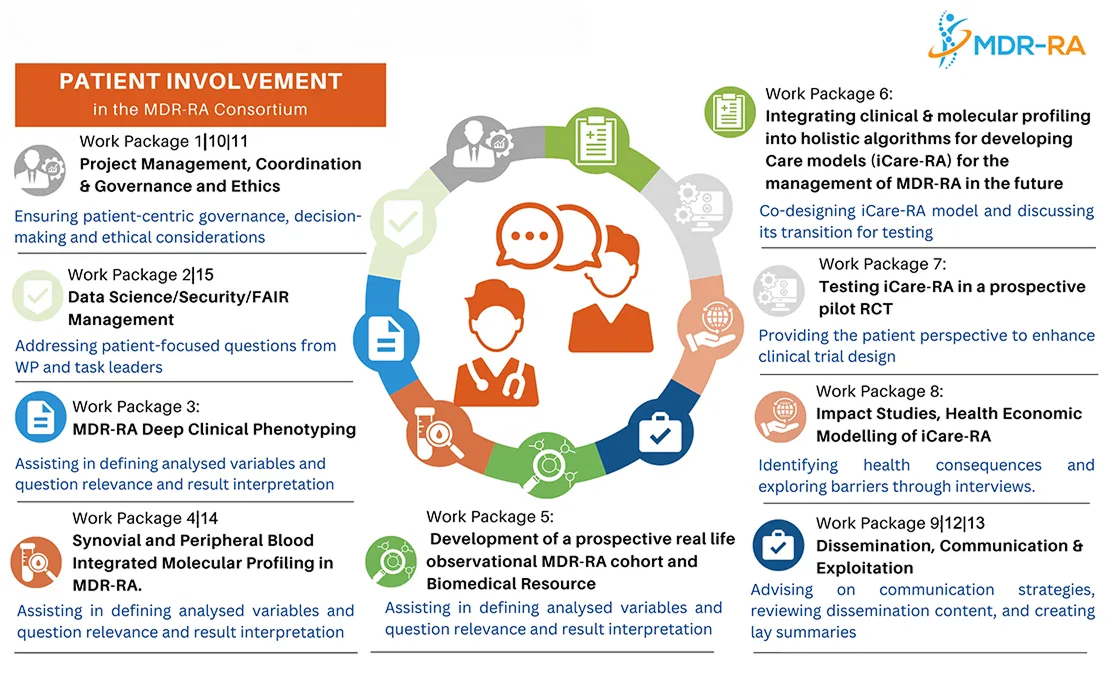
Together, the PRPs form a PatientAdvisory Panel (PAP). Each PRP is linked to one or more work packages, such as ethics, communication, health economics, or clinical research. This means patient voices are heard throughout the entire project work - from project management to dissemination and communication.
How PRPs are already shaping MDR-RA
PRPs contribute their lived experience to help make research more relevant, meaningful, and patient-centred.
They work alongside researchers, clinicians, and other experts throughout the entire project lifetime. PRPs can be involved at different stages of are search project. For example, patient partners in MDR-RA:
- Help shape the research questions, ensuring they reflect what matters most to patients (WP3,4)
- Review study materials to make sure they are clear and easy to understand (WP5,7)
- Contribute to the design of studies, including how and when data is collected (WP2,3,4,5,7)
- Take part in project meetings and discussions as equal partners while co-designing the iCare-RA model (WP1,6)
- Help interpret results by bringing in the patient perspective shape health economic discussions (WP8)
- Support communication of findings to the wider patient community (WP9)
Why does this matter?
By involving PRPs, research becomes more closely aligned with the realities of living with a condition. This improves the quality of the research and helps ensure that outcomes are meaningful and useful for patients.
Different ways people may take part
Some studies simply observe what happens in usual care and collect data over time. Others test new tools or care strategies, like the iCare-RA trial, which compares usual care with care supported by the decision tool. Not all studies are available in every country or centre. Reach out to us for more information.
Contact us through hunimed.eu
What might participation involve?
- Regular clinic visits to check your joints, symptoms, and medicines.
- Blood tests or imaging, such as ultrasound or MRI, to better understand your disease.
- Questionnaires about pain, fatigue, daily activities, and quality of life.
Your rights and data protection
Joining any study is voluntary. You can ask questions, take time to decide, and stop at any time without affecting your regular care. Data are handled according to strict European rules to protect your privacy and security.
Patient organisations working with MDR-RA
MDR-RA collaborates with patient organisations in many European countries.
They share project updates and offer information, support, and advocacy in your
language.
Learning more about RA
For broader information about RA, treatment options, and self-management, your national organisation or rheumatology society can provide trusted resources. Always talk to your healthcare team before changing any medication or treatment plan.
Patient Involvement in MDR-RA
Patient involvement and engagement is central to the success of MDR-RA, ensuring that the lived experiences and perspectives of people with rheumatoid arthritis guide every stage of our research and innovation.
From the beginning, the strategy was co-designed by EULAR, the Principal Investigator of the project, clinicians, and consortium partners to ensure that the patient voice is embedded in every stage of the research.
By making patients true partners in the project, MDR-RA aims to deliver solutions that are meaningful, practical, and impactful for those most affected.
How it started
Patient involvement in the MDR-RA project began at the earliest stages. Patient Research Partners (PRPs) from EULAR contributed to the project’s conception and planning.
Working side-by-side with the Principal Investigator, Work Package Leaders, and the wider research team, PRPs were dedicated in the writing of the project proposal. Their lived experience with difficult-to-treat rheumatoid arthritis shaped key parts of the proposal - especially the impact section, where ensuring relevance and accessibility to people affected by the condition was essential. With PRP input, communication strategies and key performance indicators were refined so that the project’s outputs will reach the patients and communities who need them most.
EULAR’s role was central to this process. As an organisation with deep expertise in supporting patient engagement across EU-funded consortia, EULAR coordinates the involvement of PRPs, facilitates contributions to patient organisations, and ensures that patient participation is not tokenistic but meaningful, visible, and valued. Through this collaborative effort, patient involvement is embedded as a fundamental principle guiding MDR-RA’s research design and implementation.
Patient Involvement strategy
Nine patient representatives who come from across Europe - the United Kingdom, Norway, the Netherlands, Cyprus, Greece, Switzerland, Germany, Portugal - bringing a rich diversity of experience that strengthens every aspect of our work.
The MDR-RA PAP provides essential guidance to MDR-RA project, with patient needs, priorities, and expectations informing each stage of the work. While the full PAP supports the overall direction of the project, each member also provides targeted input to specific work packages:
To make sure PRPs can contribute effectively, we designed a tailored support process:
- WP1 - Patient insights provided by Souzi Makri and Mariana Carvalho
- WP2 - Highly technical; the full panel contributes when specific input is requested and is influenced by the discussions taking place in WP3
- WP3 & WP4 - Directly supported by Katerina, with dedicated EULAR-facilitated meetings for full panel input
- WP5 - Supported by Katerina Apostopoulou and Maryam Azimi
- WP6 - Supported collaboratively by Souzi Makri, Katerina Apostopoulou, Mariana Carvalho, Maryam Azimi, Birgit Barten, Chloe Baird, and Sadé Asker
- WP7 - Supported by Birgit Barten, Katerina Apostopoulou, and Katy Antonopoulou
- WP8 - Supported by Birgit Barten, Chloe Baird, Katy Antonopoulou, Maryam Azimi, Sadé Asker, and Ria Brokken
- WP9 - Led by Katy Antonopoulou, with materials and contributions provided by the full panel
This webpage is both a celebration of our panel members and an acknowledgment of the important work they do. The commitment and passion from PAP are instrumental in keeping the MDR-RA project grounded in the lived experiences of people with RA and centred on meaningful, patient-partnered research. In doing so, it offers an example of meaningful patient involvement that other research initiatives can aspire to.
“PRPs are not their diagnosis. They are individuals with unique experiences, and through their participation, they can widen the perspectives of research.” - Maryam Azimi (MDR-RA patient representative)
Patient organisations engagement
How it began
From the very beginning, the leadership of the project - under the initiative of Professor Costantino Pitzalis, Principal Investigator (PI) - recognised that meaningful patient engagement needed to go far beyond the traditional patient involvement model. While the establishment of a Patient Advisory Panel (PAP) was a key step, Prof. Pitzalis strongly believed that to truly help people living with difficult-to-treat rheumatoid arthritis (D2TRA), a broader, sustained connection with the wider patient community was essential.This belief laid the foundation for a unique engagement strategy that EULAR developed: reaching out directly to each EULAR PARE member organisation in the 12 countries represented in the consortium – along with two additional UK-based organisations, National Rheumatoid Arthritis Society (NRAS) and Versus Arthritis.
Why does this matter?
The goal was clear: to create abridge between the consortium and patient communities, ensuring that awareness of this important project reaches the people it is designed to support. Through this collaboration, we aim to provide regular updates and relevant information in a way that is accessible, and easy to understand for patients, while also strengthening connections between national investigators and their patient organisations.
This strategy reflects the philosophy of the MDR-RA project - not just treating disease, but listening, learning, and acting in partnership with those who live with it. By increasing awareness, strengthening collaboration, and creating channels for timely communication, we hope to bring renewed attention and, ultimately, hope to patients navigating the complexities of D2TRA.
Patient Organisations supporting MDR-RA
1 Österreichische Rheumaliga Austria
2 ReumaNet vzw Belgium
3 Gigtforeningen. Denmark
4 Deutsche Rheuma-Liga Bundesverband e.V. Germany
5 Associazione Nazionale Malati Reumatici ANMAR Onlus Italy
6 National Association ReumaZorg Nederland Netherlands
7 Norsk Revmatikerforbund Norway
8 Portuguese League Against Rheumatism. Portugal
9 Liga Reumatológica Española - LIRE Spain
10 Reumatiker förbundet Sweden
11 RLS - Rheumaliga Schweiz Switzerland
12 Arthritis and Musculoskeletal Alliance ARMA United Kingdom
13 The National Rheumatoid Arthritis Society United Kingdom
14 Versus Arthritis United Kingdom
Get involved
What does getting involved mean?
Patient organisations across Europe play an important role in helping the MDR-RA project stay connected with people living with difficult-to-treat rheumatoid arthritis. We welcome other organisations who may be interested in joining this network.
Supporting the project is flexible and does not require a formal commitment. Patient organisations that join typically:
• receive regular updates about the project in patient-friendly language
• are invited to occasional online meetings/webinars to learn about progress and exchange perspectives
• share lay summaries or project information with their members when relevant
• help raise awareness about ongoing research related to multi-drug-resistant rheumatoid arthritis
Each organisation can decide how and to what extent it would like to contribute. Even small actions - such as sharing information through newsletters, websites, social media, or helplines - can help ensure that people living with difficult-to-treat rheumatoid arthritis remain informed about research developments.
Who can you contact?
If your organisation is interested in joining the MDR-RA patient organisation network, we would be very pleased to hear from you.
Please contact: mdr@mdr-ra.eu
What happens after you get in touch?
After you contact us, we will include your organisation in our contact list and make sure you stay informed and involved in a way that fits your interests and capacity.
There is no formal obligation to participate. Our aim is simply to stay connected with patient organisations and ensure that information about ongoing research reaches the communities it is intended to support.
Patient resources: coming soon